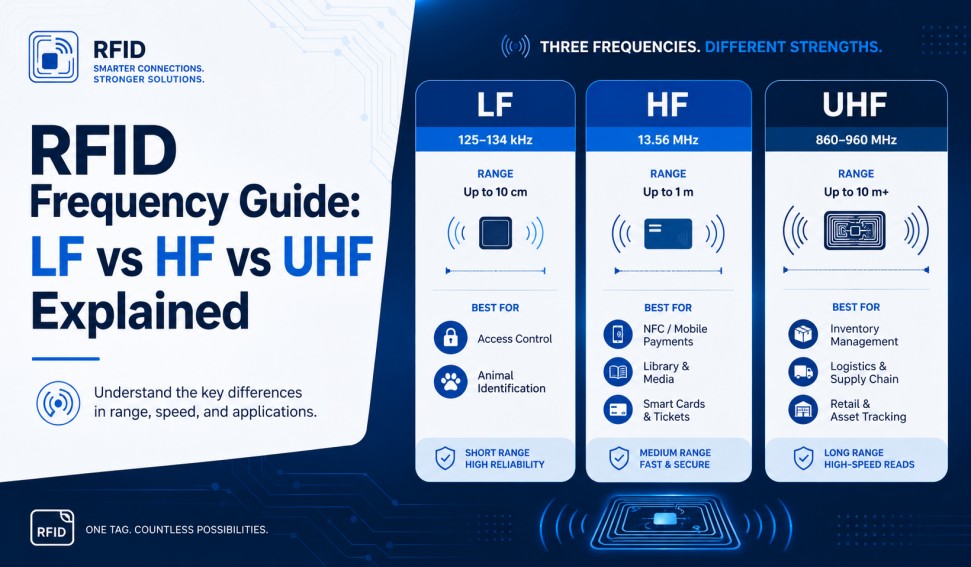
RFID Frequency Guide: LF vs HF vs UHF Explained
RFID frequency is one of the most important decisions in an RFID project. It influences communication method, practical read distance, tag size, data speed, sensitivity to surrounding materials, reader infrastructure, standards, and suitable applications.
RFID is not one single technology operating at one frequency. Most commercial systems fall into three main groups: low frequency, high frequency, and ultra-high frequency. NFC operates within the high-frequency band but has its own specifications and user experience.
This guide compares LF, HF, NFC, and UHF RFID so businesses can select the right technology for their workflow rather than choosing based only on the longest advertised read range.
RFID Frequency Bands at a Glance
| RFID type | Common operating band | Typical interaction style | Common applications |
|---|---|---|---|
| LF RFID | Approximately 125-134.2 kHz | Very short-range, near-field magnetic coupling | Animal identification, immobilizers, industrial identification |
| HF RFID | 13.56 MHz | Short-range, near-field magnetic coupling | Libraries, access cards, tickets, documents, healthcare |
| NFC | 13.56 MHz | Tap or very close interaction, smartphone compatible | Payments, authentication, smart packaging, digital content, access |
| UHF RFID / RAIN RFID | Region-specific bands within roughly 860-960 MHz | Far-field backscatter, fast multi-tag identification | Retail, logistics, warehousing, manufacturing, asset tracking |
These descriptions are useful starting points, not performance guarantees. Real read distance depends on tag design, reader power, antenna, regulations, tagged material, orientation, and environment.
Why Frequency Changes RFID Performance
Frequency affects how radio energy travels and interacts with objects.
Lower-frequency LF and HF systems commonly use magnetic coupling in the near field. The tag and reader interact over a relatively short distance. This can be valuable when the user must intentionally present one credential or one tagged object.
Passive UHF systems commonly use electromagnetic propagation and backscatter. They can support longer read zones and rapid identification of many tags, making them suitable for inventory and supply-chain automation.
No frequency is universally better. Each solves a different operational problem.
LF RFID
What Is LF RFID?
Low-frequency RFID normally operates around 125 kHz or 134.2 kHz, depending on the application and standard. LF systems have relatively slow data transfer and short read distances, but they can provide stable close-range identification in applications where speed and long range are not priorities.
Advantages of LF RFID
-
Controlled short read zone
-
Established use in animal identification and vehicle immobilizers
-
Can be less sensitive than UHF to some challenging materials and orientations
-
Suitable for small, durable transponders
-
Straightforward one-at-a-time identification workflows
Limitations of LF RFID
-
Short read distance
-
Lower data rates
-
Limited suitability for high-speed bulk inventory
-
Readers and tags can be more specialized for the target application
Common LF RFID Applications
-
Livestock identification
-
Pet microchips
-
Animal ear tags and boluses
-
Automotive immobilizer transponders
-
Industrial process identification
-
Tool or component identification at close range
LF is often selected because the application requires a deliberate, controlled read rather than maximum distance.
HF RFID
What Is HF RFID?
High-frequency RFID operates at 13.56 MHz. HF systems use near-field magnetic coupling and are widely used for cards, tickets, libraries, document management, healthcare, and product interaction.
Advantages of HF RFID
-
Internationally recognized 13.56 MHz operating frequency
-
Controlled short-range communication
-
Mature card and label ecosystem
-
Suitable for item-level identification and user-presented interactions
-
Available with many memory and security options, depending on the chip
Limitations of HF RFID
-
Usually shorter range than UHF inventory systems
-
Less suitable for reading large groups of items from several meters away
-
Performance still depends on antenna size, orientation, materials, and reader design
Common HF RFID Applications
-
Library books and media
-
Access cards
-
Electronic tickets
-
Document tracking
-
Healthcare identification
-
Industrial workstations
-
Contactless smart cards
HF is a strong choice when the process benefits from a controlled close-range read and established card or label standards.
NFC
Is NFC the Same as HF RFID?
NFC operates at 13.56 MHz and belongs to the wider HF RFID family, but the terms are not interchangeable.
NFC is designed for close, intentional interactions between compatible devices and tags. A major advantage is support in many smartphones, allowing a consumer or employee to interact with an NFC tag without a dedicated industrial reader.
Advantages of NFC
-
Smartphone compatibility
-
Intuitive tap interaction
-
Suitable for consumer engagement and product authentication
-
Can support secure applications when appropriate chips and system design are used
-
Useful for linking a physical item to digital information
Common NFC Applications
-
Contactless payment
-
Product authentication
-
Smart packaging
-
Digital business cards
-
Access control
-
Device pairing
-
Maintenance instructions
-
Membership and loyalty experiences
NFC is usually chosen for intentional one-to-one interaction, not high-volume warehouse inventory.
UHF RFID and RAIN RFID
What Is UHF RFID?
Passive UHF RFID operates in region-specific bands within the broader UHF range. In supply-chain applications, it is commonly called RAIN RFID and normally uses the GS1 EPC Gen2 air-interface protocol or its ISO/IEC 18000-63 equivalent.
UHF systems can identify many tagged items quickly and at greater distances than most passive LF or HF applications.
Advantages of UHF RFID
-
Longer practical read range
-
Fast multi-tag inventory
-
Suitable for fixed portals and handheld readers
-
Economical passive labels for large deployments
-
Strong ecosystem for retail, logistics, and manufacturing
-
Supports item-level, carton-level, pallet-level, and asset identification
Limitations of UHF RFID
-
Metal and liquids can significantly affect performance
-
Read zones require careful engineering
-
Regional frequency and power rules vary
-
Unintended reads can occur if the zone is not controlled
-
Small items and difficult packaging may require specialized inlays
Common UHF RFID Applications
-
Retail inventory
-
Apparel source tagging
-
Warehouse receiving and shipping
-
Pallet and carton tracking
-
Manufacturing work-in-process
-
Tool and equipment tracking
-
Automotive component tracking
-
Asset audits
-
Returnable transport item management
UHF is often the best choice when the goal is automated inventory visibility across many items.
LF vs HF vs UHF RFID Comparison
| Factor | LF | HF / NFC | UHF / RAIN |
| Typical read style | Close, controlled | Close, controlled | Short to long read zones |
| Multi-tag inventory | Limited | Possible in some HF systems | Core strength |
| Smartphone support | No | NFC: yes | Usually requires dedicated reader |
| Sensitivity to metal and liquid | Application dependent | Application dependent | Often significant |
| Common tag forms | Animal transponders, key fobs, industrial tags | Cards, labels, tickets, wristbands | Labels, inlays, hangtags, hard tags, on-metal tags |
| Best-known use cases | Animal ID, immobilizers | Access, libraries, NFC interaction | Retail, logistics, manufacturing, assets |
| Infrastructure | Dedicated LF reader | HF/NFC reader or phone for NFC | Handheld, fixed, portal, tunnel, cabinet |
Frequency Is Not the Same as Power Source
A common mistake is to compare LF, HF, and UHF with passive and active RFID as though they are the same classification.
They describe different things:
-
Frequency describes the radio band used for communication.
-
Power source describes whether the tag has its own battery and transmitter.
Most retail UHF labels are passive. Many HF access cards are passive. Some active systems operate at other frequencies and use a battery-powered transmitter.
How Materials Affect Frequency Selection
Metal
Metal can reflect radio waves and detune tag antennas. Standard UHF labels usually perform poorly when attached directly to metal. On-metal UHF tags use a spacer, engineered antenna, or other structure that allows the metal surface to become part of the intended design.
HF and LF systems can also be affected by metal, especially when the tag antenna is placed directly against a conductive surface. Specialized construction may still be required.
Liquids
Water-rich products can absorb or alter RF energy. UHF tags on beverages, cosmetics, pharmaceuticals, and other liquids need careful antenna selection and placement.
The correct solution may involve moving the tag away from the liquid, changing orientation, selecting a specialized inlay, or using a different frequency.
Small Items
Very small products restrict antenna size. The smallest possible label is not always the best-performing label. Testing should balance form factor and required read reliability.
High Temperature and Chemicals
Frequency alone does not determine environmental durability. Face material, adhesive, encapsulation, substrate, chip attachment, and antenna material must also match the process.
How to Choose the Right RFID Frequency
Choose LF When:
-
The application requires very short-range identification
-
Animal identification standards are involved
-
One-at-a-time reading is acceptable
-
A durable embedded transponder is needed
Choose HF When:
-
The process uses cards, tickets, documents, or library items
-
A controlled close-range read is desirable
-
The selected chip and standard fit the security or memory requirements
Choose NFC When:
-
Smartphones must interact with the tag
-
The user experience is a deliberate tap
-
Product content, authentication, pairing, or engagement is required
Choose UHF When:
-
Multiple items must be read quickly
-
Inventory counting and automation are priorities
-
The system uses handheld readers, portals, tunnels, shelves, or cabinets
-
Item, carton, pallet, asset, or work-in-process visibility is required
Questions to Ask Before Selecting a Frequency
-
What object is being tagged?
-
Is it made of metal, glass, plastic, paper, textile, or liquid-filled packaging?
-
How far away should it be read?
-
Must the system read one tag or many tags at once?
-
Will a smartphone be used?
-
Is the interaction intentional or automatic?
-
What regional radio regulations apply?
-
What are the environmental conditions?
-
What tag size is available?
-
Which standards must the system support?
Frequently Asked Questions
Which RFID frequency has the longest range?
Passive UHF RFID usually supports the longest practical read distances among common passive LF, HF, and UHF systems. Active RFID can operate over longer distances because the tag has its own transmitter. Actual range must be tested in the target environment.
Is NFC HF RFID?
NFC operates at 13.56 MHz and is part of the broader HF RFID family. It uses NFC-specific specifications and is designed for close interactions, including smartphone-to-tag communication.
Can one RFID reader read LF, HF, and UHF tags?
Normally, a reader is designed for a specific frequency and protocol. Multi-technology devices exist, but the antenna, RF circuitry, and software must support each required technology.
Is UHF RFID legal worldwide?
UHF RFID is used globally, but authorized frequencies, channel plans, output power, and operating rules vary by country or region. Readers must be configured and certified for the intended market.
Does a higher frequency always mean better performance?
No. Higher frequency may support different range and data characteristics, but performance depends on the application. A short-range LF, HF, or NFC system may be more reliable and secure for a controlled interaction.
Conclusion
The correct RFID frequency depends on the business process, tagged material, read-zone requirement, user interaction, environment, and standards. LF is well suited to controlled identification such as animal tracking. HF supports cards, libraries, tickets, and close-range item identification. NFC adds smartphone interaction. UHF and RAIN RFID provide fast multi-item visibility for retail, logistics, manufacturing, and asset tracking.
The safest selection method is to test representative tags on the real item in the real environment before committing to production.
Need help selecting an RFID frequency and tag construction? GSRFID can evaluate your item material, label size, read distance, reader type, environment, and regional requirements to recommend suitable RFID labels, tags, cards, wristbands, readers, and antennas.