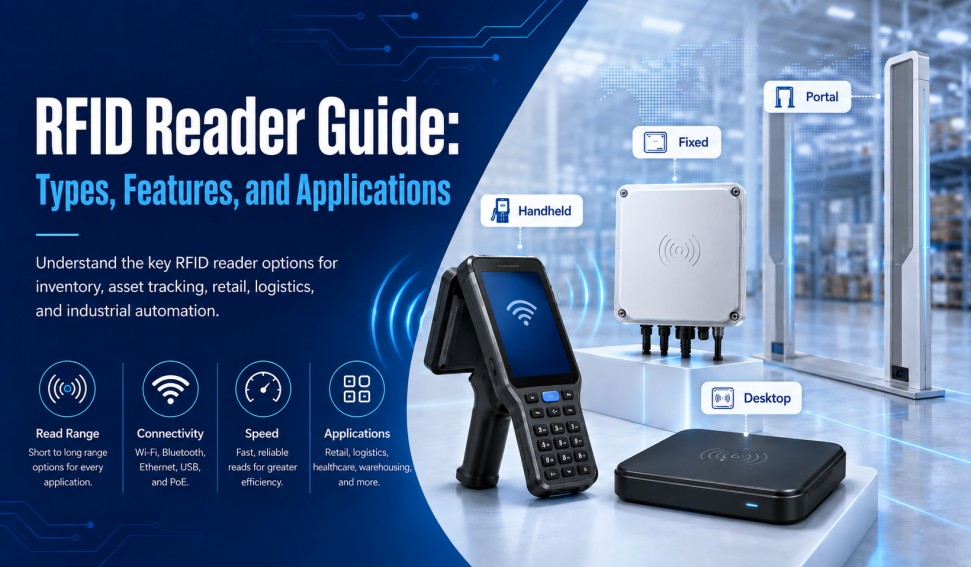
An RFID reader is the device that communicates with RFID tags and sends captured data to software. It may be a small desktop unit used to encode one label, a handheld terminal used for inventory, a fixed reader connected to several antennas, or a complete portal that automatically records tagged goods moving through a doorway.
Choosing the right reader is not simply a matter of selecting the longest range or highest output power. The reader must support the correct frequency, protocol, antenna system, tag population, network interface, environmental rating, software integration, and operational workflow.
This guide explains how RFID readers work, the main reader types, important specifications, and how to select a practical reader architecture.
What Is an RFID Reader?
An RFID reader, sometimes called an interrogator, sends and receives radio-frequency signals through one or more antennas. It performs several tasks:
-
Creates or controls the RF field
-
Sends commands to compatible RFID tags
-
Receives tag responses
-
Decodes tag identifiers and other data
-
Filters and reports read events
-
Writes or locks supported tag memory when authorized
-
Connects RFID data to local or cloud software
The reader is the communication hub of the RFID system. It does not replace the business application. Inventory rules, asset records, alerts, user permissions, and process logic normally live in software above the reader layer.
How an RFID Reader Works
A typical read cycle follows this sequence:
-
The reader sends an RF signal to an antenna.
-
The antenna creates a read zone.
-
Compatible tags in the zone respond.
-
The reader coordinates responses when multiple tags are present.
-
The reader decodes the returned data.
-
Software filters duplicates and applies context.
-
A business system records or acts on the event.
With passive UHF RFID, the reader field also supplies energy to the tag. With HF or LF systems, communication normally uses near-field magnetic coupling. Active RFID readers receive transmissions from battery-powered tags according to the active system design.
Main Components of an RFID Reader
RF Module
The RF module generates and receives the radio signal. It determines the supported frequency band, protocol, transmit power range, receiver sensitivity, and regulatory configuration.
Processor and Firmware
The processor controls tag inventory, command timing, filtering, antenna switching, communication interfaces, diagnostics, and local applications.
Antenna Ports or Integrated Antenna
A fixed reader may connect to several external antennas. An integrated reader combines the reader and antenna in one enclosure, simplifying installation for a single controlled read zone.
Communication Interfaces
Common interfaces include:
-
Ethernet
-
Wi-Fi
-
Bluetooth
-
USB
-
Serial communication
-
Cellular connectivity
-
GPIO inputs and outputs
-
Industrial interfaces or optional modules
The appropriate interface depends on the site network, host software, mobility, latency, and automation equipment.
Power Supply
Readers may use an external power adapter, Power over Ethernet, vehicle power, rechargeable batteries, or industrial DC input.
Enclosure
Indoor readers may use a standard office or equipment-room enclosure. Industrial readers may require resistance to dust, moisture, vibration, impact, cleaning chemicals, or temperature extremes.
Types of RFID Readers
Fixed RFID Readers
A fixed reader is installed at a known location and normally connects to one or more external antennas.
Best For
-
Warehouse dock doors
-
Conveyor lines
-
Manufacturing stations
-
Store exits or transition zones
-
Asset rooms
-
Smart shelves
-
Cabinets and workcells
Advantages
-
Continuous automatic operation
-
Multiple antenna support
-
Network and software integration
-
GPIO control for lights, alarms, sensors, and gates
-
Suitable for repeatable read zones
Considerations
A fixed reader requires careful antenna placement and zone control. The installation should distinguish intended movements from tags that are merely nearby.
Handheld RFID Readers
A handheld reader combines an RFID engine, antenna, controls, display or mobile computer, battery, and wireless connectivity.
Best For
-
Inventory counting
-
Locating missing items
-
Receiving and cycle counts
-
Asset audits
-
Store replenishment
-
Maintenance and field service
Advantages
-
Flexible and mobile
-
Fast deployment
-
Useful for exception handling
-
Can combine RFID and barcode scanning
-
Allows the operator to search different locations
Considerations
Performance depends on how the operator moves, aims, and configures the reader. Training and application design are important for repeatable results.
Desktop and USB RFID Readers
Desktop readers create a small, controlled read or encode zone near a workstation.
Best For
-
Tag commissioning
-
Encoding RFID labels or cards
-
Check-in/check-out
-
Library desks
-
Document registration
-
Product or asset association
Advantages
-
Controlled short-range operation
-
Easy connection to a computer
-
Convenient for one-at-a-time workflows
-
Reduced risk of reading distant tags
Considerations
A desktop reader is not intended to replace a warehouse portal or handheld inventory device.
Integrated RFID Readers
An integrated reader contains the RF electronics and antenna in one housing.
Best For
-
Wall or ceiling mounting
-
Kiosks
-
Compact portals
-
Workstations
-
Parking or vehicle identification
-
Simple single-zone installations
Advantages
-
Fewer cables and components
-
Faster installation
-
Compact design
-
Factory-matched reader and antenna
Considerations
The fixed antenna pattern may be less flexible than a separate reader with external antennas.
Gate and Portal Readers
An RFID gate or portal combines readers, antennas, mounting structures, shielding, sensors, software, and sometimes lights or alarms.
Best For
-
Dock doors
-
Warehouse transitions
-
Retail exits
-
Personnel or asset movement
-
Laundry and textile flows
-
Vehicle access
Advantages
-
Automatic movement capture
-
Clearly defined business event
-
Can integrate with direction sensors and alarms
-
Reduces manual scanning
Considerations
A portal must be engineered for the doorway width, tag orientation, traffic speed, nearby inventory, metal structure, and direction logic.
RFID Tunnels, Cabinets, and Smart Shelves
These are application-specific systems built around RFID readers and antennas.
-
RFID tunnel: Reads cartons, totes, or products moving through an enclosed zone.
-
RFID cabinet: Monitors tagged items inside a controlled storage enclosure.
-
RFID smart shelf: Detects item presence or changes on a shelf.
-
RFID workstation: Identifies products or components at a process station.
Enclosure and antenna design help reduce stray reads and improve repeatability.
RFID Reader vs RFID Antenna
The reader and antenna perform different jobs.
-
The reader generates commands, processes tag responses, and connects to software.
-
The antenna shapes the radio field and determines where communication is most likely to occur.
A high-quality reader connected to the wrong antenna or installed at the wrong angle can perform poorly. Reader selection and antenna design should be treated as one system decision.
Important RFID Reader Specifications
Supported Frequency and Protocol
The reader must match the tag technology. An LF reader cannot normally read UHF tags, and a UHF reader cannot normally read NFC tags.
Regional Frequency Support
UHF readers must operate within local frequency and power rules. A device configured for one region may not be legal or optimal in another.
Transmit Power Control
Adjustable power helps tune the read zone. The goal is sufficient coverage without creating unnecessary reads outside the target area.
Receiver Sensitivity
Receiver sensitivity influences the reader's ability to detect weak tag responses. System performance still depends on the antenna, cable loss, tag, environment, and interference.
Antenna Ports
The number of ports affects how many external antennas can be connected directly. Multiplexers can expand antenna count but may introduce switching and design considerations.
Read Rate and Dense-Reader Performance
High tag density, fast movement, and multiple nearby readers require appropriate protocol settings and reader performance. Published maximum read rates should not be treated as guaranteed application results.
Connectivity
Confirm the required interfaces, network security, API, software development kit, operating-system support, and integration protocol.
GPIO and Automation Control
Industrial and portal applications may need inputs from photoelectric sensors and outputs for stack lights, buzzers, locks, conveyors, or programmable logic controllers.
Environmental Rating
Evaluate operating temperature, ingress protection, drop resistance, vibration, cleaning requirements, and mounting conditions.
Power and Mobility
For handheld readers, battery runtime, charging method, weight, ergonomics, and wireless coverage affect daily productivity.
How to Choose the Right RFID Reader
1. Start With the Workflow
Define the exact event to capture. Is the reader supporting a manual stock count, automatic dock-door movement, item association, vehicle access, or smart-cabinet inventory?
2. Confirm the Tag Technology
Identify the frequency, protocol, chip, and tag construction. Reader and tag compatibility is mandatory.
3. Define the Read Zone
Measure the physical area, distance, traffic direction, item speed, tag orientation, and nearby inventory.
4. Select the Reader Form Factor
-
Choose handheld for mobile counting and search.
-
Choose desktop for controlled encoding or check-in.
-
Choose fixed for automatic continuous zones.
-
Choose an integrated reader for simple compact installations.
-
Choose a gate, tunnel, or cabinet for a complete controlled solution.
5. Plan the Antenna System
Select polarization, gain, beam pattern, mounting angle, cable length, and quantity. Test more than one antenna arrangement when the environment is complex.
6. Confirm Integration
Review APIs, SDKs, network protocols, data format, security, device management, and the target WMS, ERP, MES, or asset platform.
7. Test With Real Items
Use the actual products, packaging, labels, movement speed, and environmental conditions. A tabletop demonstration is not a substitute for site testing.
Common Reader Selection Mistakes
-
Choosing maximum power instead of a controlled read zone
-
Assuming one antenna covers every orientation
-
Ignoring metal, liquids, and reflections
-
Buying a reader before selecting and testing the tag
-
Focusing on hardware while neglecting middleware
-
Forgetting regional radio configuration
-
Using a fixed portal where a handheld process would be simpler
-
Using a handheld process where automatic fixed reads are required
-
Failing to define what duplicate and stray reads mean
-
Skipping pilot testing
Frequently Asked Questions
Can an RFID reader also read barcodes?
Some handheld terminals combine an RFID engine with a barcode imager. Fixed RFID readers usually require a separate barcode scanner if both technologies are needed.
Can one reader use multiple antennas?
Many fixed readers support several antenna ports. The reader switches among antennas according to its configuration. Antenna quantity and switching speed should match the workflow.
How far can an RFID reader read?
Range is a system result, not a reader-only specification. It depends on frequency, reader power, antenna, cable loss, tag design, orientation, material, regulations, and environment.
Can an RFID reader write data to a tag?
Many readers can write supported tag memory when the tag, protocol, permissions, and software allow it. Encoding must be validated to prevent duplicate or incorrect identifiers.
Do RFID readers need internet access?
Not necessarily. A reader can operate on a local network or directly connected to a computer. Cloud applications require a route to the cloud service, but edge software can continue some functions during a network interruption.
Conclusion
The right RFID reader depends on the frequency, tag, read zone, workflow, integration, environment, and user experience. Handheld readers offer flexible inventory and search. Fixed readers automate repeatable locations. Desktop readers control close-range encoding. Integrated readers simplify installation, while gates, tunnels, cabinets, and shelves provide complete application-specific read zones.
Reader performance should always be evaluated together with the antenna, tag, software, and real operating environment.
Need help selecting RFID readers and antennas? GSRFID supplies handheld RFID readers, fixed RFID readers, desktop readers, long-range readers, gate readers, antennas, and related RFID equipment. Share your tag type, read distance, installation area, software interface, and operating conditions for a practical recommendation.