Introduction
RFID technology has become one of the most important identification technologies for modern supply chains, retail operations, manufacturing, and asset management.
Unlike traditional barcode systems, RFID enables automatic identification and data collection without requiring direct line-of-sight scanning. This allows companies to improve inventory accuracy, increase operational efficiency, and build smarter connected environments.
But what exactly is RFID technology? How does it work, and why are more businesses adopting RFID solutions?
This guide explains the fundamentals of RFID technology and its practical applications.
What Does RFID Stand For?
RFID stands for Radio Frequency Identification.
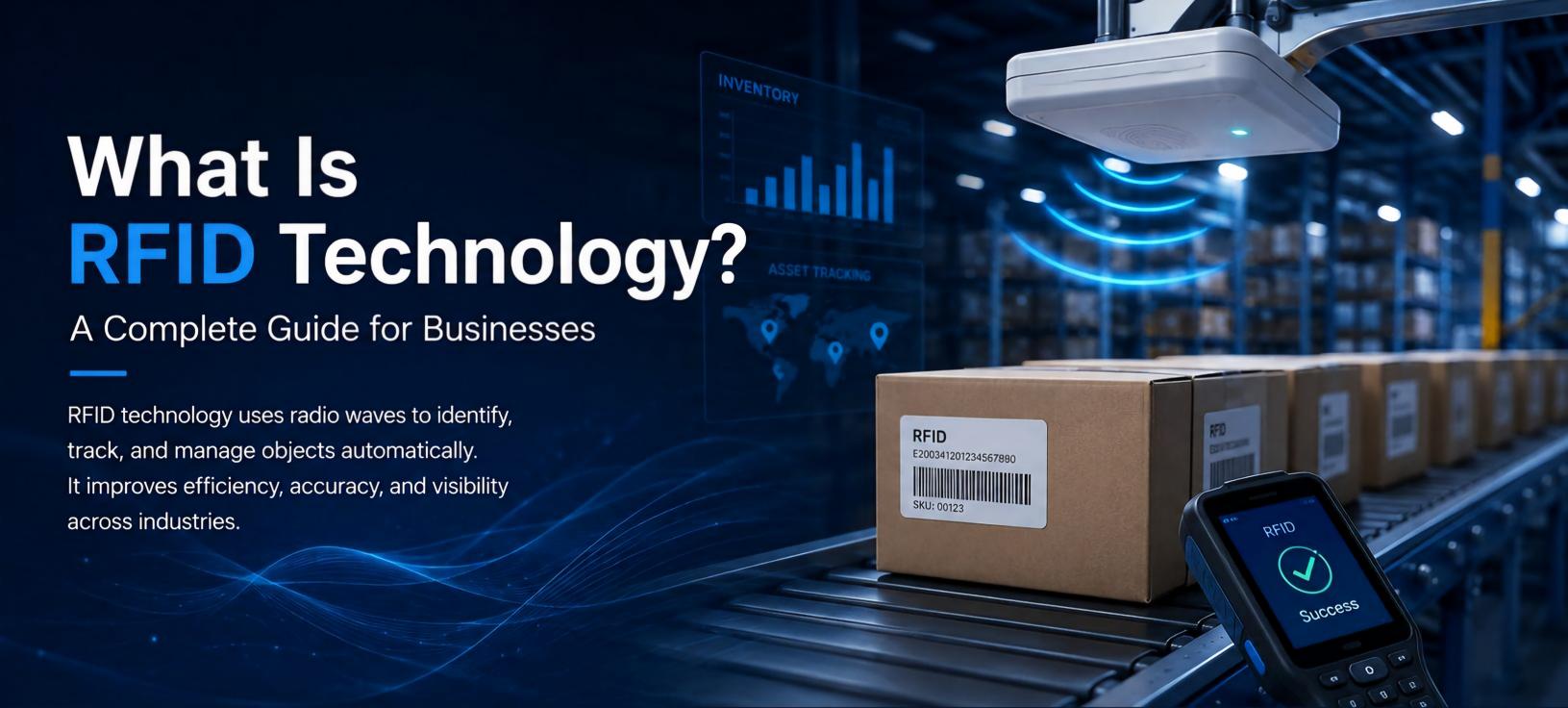
It is a wireless technology that uses radio waves to identify, track, and manage objects attached with RFID tags.
An RFID system typically consists of three main components:
- RFID Tag
- RFID Reader
- RFID Software System
Together, these components allow businesses to collect product information automatically and transmit data to management systems.
How Does RFID Technology Work?
The working process of RFID is based on communication between RFID tags and readers.
The basic process includes:
Step 1: RFID Reader Sends Radio Signals
The RFID reader generates electromagnetic waves through its antenna.
Step 2: RFID Tag Receives Energy
Passive RFID tags receive energy from the reader signal and activate the embedded chip.
Step 3: Data Transmission
The RFID chip sends stored information back to the reader.
Step 4: Data Processing
The collected information is transmitted to software platforms for inventory management, tracking, or analytics.
Unlike barcodes, RFID tags can often be read:
- Without direct visibility
- Through packaging materials
- Multiple tags simultaneously
What Are the Main Components of an RFID System?
1. RFID Tags
An RFID tag contains:
- RFID chip
- Antenna
- Substrate material
RFID tags are available in many formats:
- RFID labels
- RFID inlays
- RFID cards
- RFID wristbands
- Industrial RFID tags
- On-metal RFID tags
Different applications require different tag designs.
2. RFID Readers
RFID readers communicate with tags and collect information.
Common types include:
- Fixed RFID readers
- Handheld RFID readers
- Integrated RFID readers
They are widely used in:
- Warehouses
- Retail stores
- Manufacturing facilities
- Hospitals
3. RFID Software
The software layer manages collected RFID data.
Typical functions include:
- Inventory management
- Product tracking
- Asset monitoring
- Data analysis
Types of RFID Technology
RFID is generally divided into three frequency categories.
Low Frequency (LF RFID)
Frequency range:
125-134 kHz
Applications:
- Animal identification
- Access control
- Industrial tracking
High Frequency (HF RFID)
Frequency:
13.56 MHz
Applications:
- NFC applications
- Smart cards
- Library management
- Payment systems
Ultra High Frequency (UHF RFID)
Frequency:
860-960 MHz
Applications:
- Retail inventory
- Logistics
- Manufacturing
- Supply chain management
UHF RFID is currently one of the most widely used RFID technologies for industrial applications.
RFID Technology vs Barcode Technology
| Feature | RFID | Barcode |
|---|---|---|
| Reading method | Radio waves | Optical scanning |
| Line of sight | Not required | Required |
| Multiple reading | Yes | Usually one at a time |
| Data capacity | Higher | Limited |
| Automation capability | Excellent | Moderate |
For companies managing thousands or millions of items, RFID provides significant efficiency improvements.
Benefits of RFID Technology for Businesses
Improved Inventory Accuracy
RFID allows companies to automatically track inventory movements and reduce manual counting errors.
Higher Operational Efficiency
Employees can complete inventory tasks faster compared with traditional scanning methods.
Better Supply Chain Visibility
Companies gain real-time information about product locations and movement.
Enhanced Data Management
RFID creates valuable operational data for analysis and optimization.
Common RFID Applications
RFID technology is widely used across industries.
Retail
Applications:
- Apparel tagging
- Inventory management
- Loss prevention
Manufacturing
Applications:
- Work-in-process tracking
- Tool management
- Production monitoring
Logistics
Applications:
- Warehouse automation
- Shipment tracking
- Distribution management
Healthcare
Applications:
- Medical asset tracking
- Patient management
- Pharmaceutical monitoring
Choosing the Right RFID Solution
Selecting the correct RFID solution depends on:
- Reading distance requirements
- Operating environment
- Material compatibility
- Frequency selection
- Tag size
- Chip performance
A professional RFID manufacturer can help design the right solution according to application requirements.
Conclusion
RFID technology is transforming the way businesses identify, track, and manage physical assets.
From retail inventory to industrial automation, RFID provides a more efficient and intelligent way to connect products with digital systems.
As RFID adoption continues to grow, businesses that implement the right RFID solutions can achieve higher visibility, accuracy, and operational efficiency.
About GSRFID
GSRFID provides customized RFID labels, RFID tags, RFID cards, and RFID solutions for global businesses.
With professional manufacturing capabilities and application experience, GSRFID helps companies develop reliable RFID solutions for retail, logistics, manufacturing, automotive, healthcare, and other industries.
CTA
Need a customized RFID solution for your application?
Contact GSRFID experts for professional RFID tag design and manufacturing support.