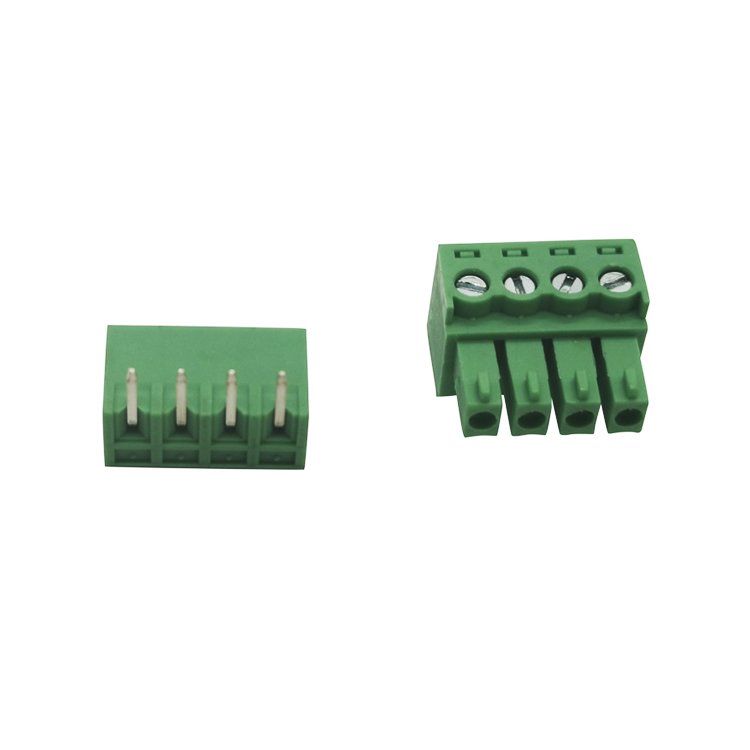
In industrial control, power systems, automation equipment, and electronic products, terminal blocks are one of the most common and critical connectors.Choosing the right type of terminal block (such as pluggable PCB terminals, screw terminals, or spring terminals) not only affects wiring efficiency but also directly impacts system stability and future maintenance costs.
I. What are Pluggable PCB Terminal Blocks?
Pluggable PCB terminal blocks consist of two parts: a plug and a base, allowing for quick insertion and removal without the need for rewiring.
This type of terminal block is widely used in modular equipment and industrial control systems.
Advantages include:
- Fast installation and maintenance
- Reliable connection and stable contact
- Suitable for PCB mounting
- Available in various pitch sizes, such as 3.5mm, 3.81mm, 5.0mm, 5.08mm, 7.5mm, and 7.62mm
II. Screw Terminal Blocks: Characteristics
Screw terminal blocks secure wires using screws, resulting in a robust structure. They are one of the most common types of terminals in industrial applications.
Main Features:
- Secure wire fixation with strong tensile strength
- Suitable for medium to high current applications
- Low cost and high versatility
- Available in various configurations, including PCB mount screw terminals, 2-pin, 3-pole, etc.
III. Spring/Screwless Terminal Blocks
Spring terminal blocks use spring clips to secure wires, eliminating the need for screws and improving assembly efficiency.
Key Advantages:
- Fast wiring, reducing labor time
- Excellent vibration resistance
- Suitable for high-density PCB designs
IV. PCB Mounting Terminals and Barrier Terminal Blocks
In applications requiring high insulation distance and safety, barrier terminal blocks are widely used,
suitable for power supplies, power control, and industrial equipment.
V. How to Choose the Right Terminal Block?
When selecting a terminal block, it is recommended to focus on:
1. Terminal spacing (Pitch)
2. Current and voltage ratings
3. Wiring method (screw/spring/pluggable)
4. PCB mounting method
5. Frequency of future maintenance
Conclusion:
Whether it's pluggable terminals, PCB-mounted terminals, or spring terminals, choosing the right terminal solution can significantly improve system stability.
As a professional terminal manufacturer and supplier, we can provide customized PCB terminal solutions for our customers.